Chronicle of a vanished web
Urban exploration had already disgusted me (see (cf. here), now the entire
Internet makes me want to vomit !
The old web isn't quite what we knew anymore...
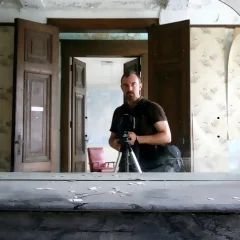
I discovered the internet in 1995 or 1996. Yes, in the last century.
Amazed by this new technology, I discovered a way to use a computer that I hadn't known existed until then. And everything seemed
magical : you could go anywhere in a virtual world where, even back then, you could discover quite a lot. It was promising...
How far removed we are from the glorious era of web pioneers with Internet Explorer, Netscape Navigator, AltaVista, Caramail, personal
web pages on Multimania or GeoCities, WebRings with NavBars, animated GIFs, and vibrant, eye-catching
colorsNote1. Or those 56K connections with their characteristic hum,
giving web surfers plenty of time to watch the Lord of the Rings trilogy while waiting for a webpage to load. And those blue,
underlined links that took two and a half hours to reach another webpage. Or even saving information gleaned from the internet
onto 3.5" floppy disks. Nostalgia...
The internet was created with the goal, among others, of the universal sharing of knowledge.
With a background in web development, it was this desire to exchange and share bits and pieces that led me to create my own
space, worldofjosh.be, in 2007. The idea was simple, almost naive today : to share my moods and photos, and a little later,
my passion for urban exploration, which had just been rekindled, and all this without any commercial aim. Just for the pleasure
of sharing, without expecting anything in return. From rudimentary pages that took longer to load than a Belgian National
Railways (NMBS/SNCB) delay came the breakthrough : Web 2.0. Based in particular on user participation and collective intelligence
(how naïve !), rather than leaving the user passively in front of web pages they could only read, Web 2.0 has Given the
emergence of sharing platforms like Facebook and YouTube, at that time, these platforms and independent websites still
coexisted peacefully. And on these platforms, genuine freedom still existed.
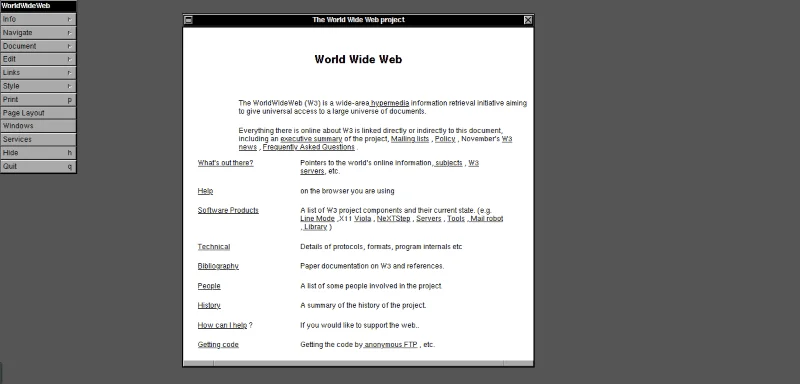
A joyful and colorful world... but not at the beginning
CERN – Image released into the public domain
The break
So, in 2007, worldofjosh.be was created.
Having your own website isn't free, far from it, when you want something unique and truly your own. Therefore, I decided
not to rely on platforms like WordPress or Webflow, which allow those who know nothing about HTML coding to have their own website.
No, I wanted to remain free and the sole master of my website. For two years, I tested, failed, succeeded, and switched from one
language to another (from ASP to PHP for those who are familiar with it) before finally publishing it to the world in 2009. But
creating such a website... It costs money : hosting and purchasing software useful for web creation are far from free...
My return ? €0,00 and that's just fine with me.
At that time, I hadn't yet created any accounts on social networks, which had grown much faster than my modest web pages. I also
had no idea what was insidiously unfolding next...
Years have passed, and this vast collaborative playground that was the internet has been transformed. Slowly but surely, finance and
algorithms have taken control. The promise of universal sharing has shattered against a wall of profitability. Today, the independent
web is dying, suffocated on one side by standardized giant platforms drowning in advertising that capture all attention, and
on the other by intellectual property sharks.
And the next chapter arrived recently in my email inbox dedicated to my website. Not in the form of a message from a history
buff or an urban explorer, as is becoming increasingly rare, no.
It was a robot, a cold, automated algorithm from a private company, that came knocking at my door. Its goal ? To demand an astronomical
sum (four figures, no less !) for a single, unfortunate archive photograph from October 2011, buried deep within my personal,
non-commercial website (I remind you).
At the same time, platforms like Facebook and YouTube reign supreme over the internet. Small content creators like me are no longer welcome.
Let me explain.
The bot I just mentioned has only one goal : to scan the entire web indiscriminately, searching for copyrighted images,
whether on a major, profitable news site or on the blog of an urban exploration enthusiast who has been sharing their
thoughts and photos online for almost 20 years.
On this point, I confess to being partly guilty. Believing that the web still functioned as it did a decade ago, I naively
thought that publishing a copyrighted image (while citing the author below the image) to illustrate my points would protect
that image from misuse and protect me from any kind of intellectual theft. How wrong I was ! Things have changed in just a
few years, and a real business has sprung up around hunting down copyrighted images. For large websites raking in huge sums
of money, it's not a problem, but for someone like me who sees my website as a sharing hobby, it's a completely different story.
On the other hand, the web giants are sucking up content from all over the world on an industrial scale (basically, everything
you post on Facebook, to sum it up) to generate billions in profits, with your consent. Of course, you're registered on these
platforms, so you were forced to accept their terms, namely, losing your rights to your personal information and photos. That's the
beauty of it...
Me, I'm an easy target for these tracking bots since I don't have an army of lawyers ready to fight tooth and nail at the slightest
lawsuit filed against the web giants.
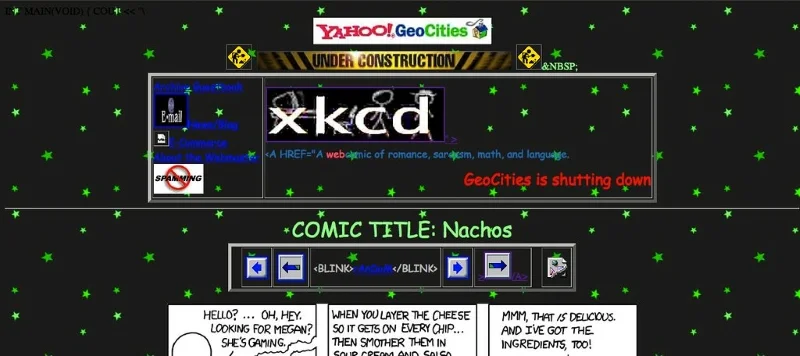
When the internet still had a soul (and questionable taste)
© secretlondon123 • Flickr
What could I do ?
Faced with this legalized extortion and sickening double standards, I made a radical decision. There's no way I'm selling
myself out to these online vultures for a 15-year-old non-commercial archive.
That's why you'll find much of my site locked today. I've chosen to remove the articles I've written over the past 20 years
and technically barricade worldofjosh.be to prevent these predatory bots from accessing it. My site remains online, my
magnificent (yes, I'm patting myself on the back) urban exploration photos are still there, but I refuse to feed the
money-making machine. The internet may have lost its soul, but I'm keeping mine. My space will remain a place for humans,
not for their algorithms.
However, my task ahead is going to be long and arduous. I'm going to have to analyze every single image I've been so foolish
as to publish on this information-sharing platform that is the internet. It's the price I have to pay for worldofjosh.be to
continue having the right to exist on the web.
Besides that, managing a site like mine is becoming increasingly difficult. While the internet giants are grabbing all the
attention, while algorithms dictate visibility, while content is being scraped, analyzed, and monetized, small websites like
mine now have to deal with legal issues, SEO, search engine bots, costs, and social media. A lot of work for no return. But that
won't stop me from keeping my website online, for the pleasure of sharing my hobby.
The "double standard" is applied with a certain ferocity on the internet : publishing the same image on Facebook or on a site like mine can have very different consequences. On social media, no problem, but on my website, it's a financial execution squad... So while internet giants can host astronomical amounts of reposted content, a small personal website finds itself under pressure for an old photo illustrating a 2011 article.
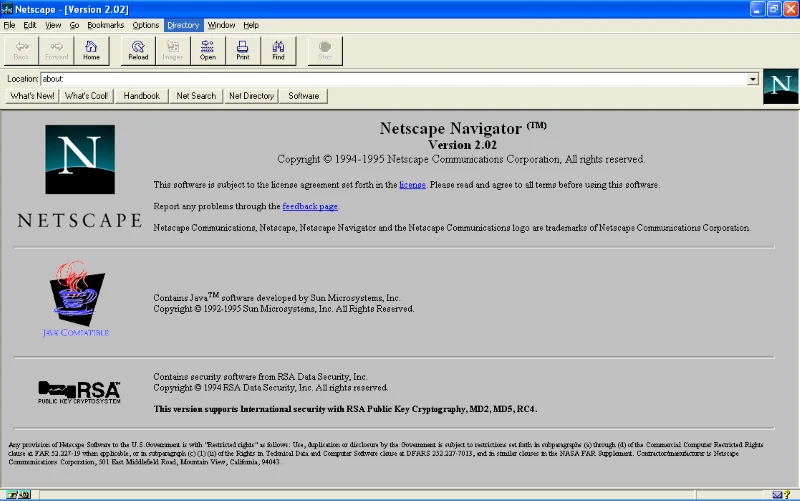
Remember...
Image released into the public domain
Lowering oneself (still) to exist (a little longer)
Previously, when an internet user wanted to browse or find information on a particular subject, they consulted search
engines, had bookmarks in their web browser, and still used URLs (the famous https://www.worldofjosh.be, for
example)Note2.
With the takeover by the web giants, all of that has disappeared. The client and target audience of advertisers (no longer
the internet user) now expects all-powerful algorithms to provide what they think they want. We no longer search the web,
we consume. We no longer want to learn online; we stay connected 24/7 to our favorite social network.
Therefore, in order for my website to still exist and have a minimum of visibility online, I was forced to create a multitude
of accounts myself on as many social media platforms. Why ? Because without them, no human would visit my website. Indeed,
everything goes through platforms like Facebook or YouTube.
For example, who would talk about a particular topic if the star influencers didn't ? They and the algorithms dictate who
can still exist on the internet and who can't.
And when I post a link to my website on social media, I have to be careful about what I say. Indeed, I've already been banned
because my content (urban exploration photos, as a reminder) didn't appeal to social media algorithms and because, supposedly,
I had violated the sacrosanct "Community Standards." Of course, I never received the slightest justification for these bans,
nor any means of defending myself. And all this just to hope that a few people would click on my link to visit my website.
To take an example from the rotten world of urban exploration, the vast majority of explorers simply post their photos or videos
on social media, and that's it. I, for one, have chosen a completely different approach.
The advent of smartphones has also changed many things in the way we consume the internet. Before these addictive devices, browsing
the web required a PC, sitting down, and taking your time. With smartphones, the internet is certainly available all the
time (unfortunately), but everything has to be fast since people are on it while walking, eating, driving, going to the
bathroom, sleeping, dying, and forgetting to stay in real contact with others. So there's no longer much time to try to
appreciate things; you have to consume as many ads and as much data as possible.
Similarly, designing a website for a PC or a smartphone is not the same : the work is much more extensive on a phone than on
a computer, given the absence of a keyboard and mouse.
What does the future hold ?
I've always wanted to be completely independent with my website, but alas, I need social media to maintain any semblance of an
online presence.
The ultimate irony of this situation is that in order for you to read these lines, I had to share them on social media. To keep my
independent site alive, I'm forced to feed the algorithms of the internet giants, the very ones that are causing the death of the
independent web. This is the ultimate proof that the web has lost its original freedom.
And to continue to exist, I'll therefore have to continue depending on Facebook and the like, but also redo over a decade's worth of
work to avoid being at the mercy of the web's vultures.
Another irony : a few days ago, a small YouTube content creator asked me if he could use some of my urban exploration photos in a video (crediting me, of course). What should I tell him ? Okay, but you'll pay me the same amount ? No, I chose to allow it, and for free. I wouldn't want to become like those I despise...
The internet was, in its early days, a place for sharing and discovery.
Today, it's almost exclusively the domain of web giants, where simply existing has become a complicated mission. WorldofJosh.be
is nothing more than a few lines of code drowned in a money-making scheme and a showcase for idiots.
Finally, I'm not fundamentally against new technologies (smartphones, artificial intelligence, social networks, etc.), I'm
outraged by how they're used.
Just like at the beginning of the internet, we created something virtuous, but stupidity and greed have ended up corrupting these tools.
That's the way the world is.
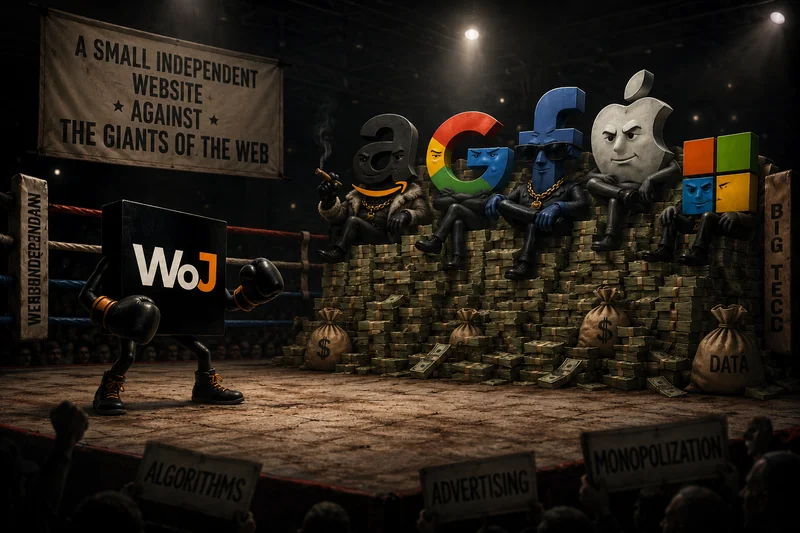
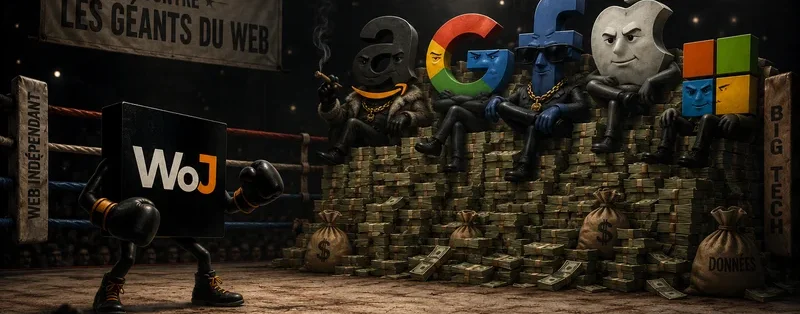
Josh vs. the web giants
An epic battle to come !
Coming soon to all your social media platforms
Please subscribe
© ChatGPTNote3
Note
- All fallen on the field of honor... RIP to them...
-
In the early days of the web, addresses were much less readable than they are today.
It wasn't uncommon to find addresses with dozens of characters, including special characters like the tilde (~). - I love irony : an AI illustrating a text criticizing the excesses of the internet.
Soyez le premier & devenez quelqu’un de bien • Be the first & become a good person